 | greenville business & community directory |
|

This is an archived page that may contain outdated or incorrect information. Please visit www.Greenville.com for the latest news, events, and more.

 To the Scottish-American immigrants, the mountainous terrain of the southern Appalachians in many ways resembled their own rocky Scottish Highlands, making it a natural choice for the many Scots who settled here in the 18th and 19th centuries. As a result, Appalachian crafts and culture, language and lore bear strong resemblance to their Scottish counterparts. In honor of these cultural connections, the Southern Highland Craft Guild is hosting a significant exhibition of Scottish craft traditions organized and supplied by the National Museums of Scotland in Edinburgh.
 "Celebrating Scotland's Crafts" makes its premier US showing at the Blue Ridge Parkway's Folk Art Center, May 4 - September 29, 2002. Curator Louise Butler, a passionate scholar of Scotland's craft traditions, has collected for this show the work of present-day craftspeople from across the Scottish Isles who practice traditions passed down in small communities since pre-industrial times. The precision work of making bagpipes as well as the distinctive Fair Isle knitwear, historic kilt tartans and much more is explored in this show boasting 106 objects, along with a brief education on their history and processes. To celebrate the mutual goals of craft preservation shared between the Southern Highland Craft Guild and the Scottish craft organizations, the Guild is sponsoring a series of Scottish cultural events, both celebratory and educational, held throughout the run of the exhibition. "Celebrating Scotland's Crafts" was festively ushered in on Saturday, May 4, with a Grand Opening Ceremony beginning at 2PM. Immediately following the ceremony in the Folk Art Center auditorium was a day of special events, including up-close experiences with Scottish arts in "Meet the Artist" sessions, an authentic Scottish supper, and closing with a traditional Ceilidh (pronounced "kay-lee"), an ancient custom where friends and neighbors gather for stories, music and dance.
The Guild is also sponsoring a special evening performance by the celebrated Scottish fiddler Alasdair Fraser on July 6 at the Diana Wortham Theatre in downtown Asheville. Widely acclaimed as the consummate performer, recording artist and teacher of Scottish music traditions, Fraser has delighted Scottish music fans worldwide with his dynamic interpretations and captivating stage presence. The exhibition is complemented by a full-color catalogue with photos by Scottish photographer Shannon Tofts. A selection of Tofts' photos on Scottish crafts will be displayed along with the exhibition. In a separate, companion exhibition in the Interpretive Area of the Folk Art Center, the Guild has joined with the Western North Carolina Fiber Guild and Scottish Heritage USA to showcase an exceptionally in-depth weaving project. Entitled "Tracing Our Threads: the Kilbarchan Weaving Project," this show displays weaving samples woven by American weavers from patterns graciously loaned by the centuries-old weaving center in Kilbarchan, Scotland. Over 70 weaving patterns that have been out of use since the 19th century are being studied for their connection with the Scots-Irish weaving traditions of the Appalachian mountains.
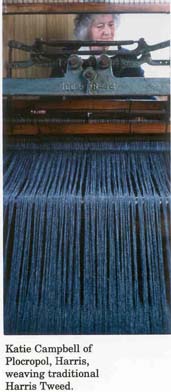
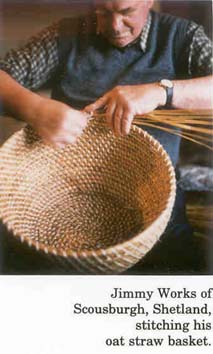
Since the late 18th century, weavers have assigned a town or family name to each pattern, but as far back as Roman times, Scottish Highlanders were identified by their "striped cloaks of many colours." The exhibition explores the manufacturing of tartans today, and how it has changed from hand weaving with yarns dyed from locally gathered berries, barks and lichens to industrial power looms with chemical dyes. Scotland at one time supported an estimated 78,000 hand-weavers. Today, as in the US, just a handful carry on the tradition, almost as a hobby. The Northern Isles of Scotland are famous for their distinctive straw-back chairs. As timber on the windy northern isles is scarce and often reserved for boat making, Orkney chair are supported by thin wooden frames and made almost entirely of densely woven oat straw. Some designs feature a woven straw hood and many include a woven sea-grass seat. Most of the present-day Orkney chairmakers reside in Orkney, but a similar tradition of chair making exists on Fair Isle, the southernmost of the Shetland Islands. Scottish straw-back chairs gained increased attention during the Arts and Crafts period in Europe, and during the early 20th century, their unique design attracted large furniture retailers, as well as the Royal Family, consigned from David Munro Kirkness. As each chair takes roughly a week to make with a handful of makers keeping the tradition, Orkney chairs have become a rare treasure of Scottish craftsmanship.
"Celebrating Scotland's Crafts" also features coastal and island boat making, basket weaving, Fair Isle knitting, and natural dying, to name a few. Major funding for "Celebrating Scotland's Crafts" is from The Scottish Arts Council and Jean Muir, Ltd. All exhibitions at the Folk Art Center are free of charge unless otherwise noted. To get to the Folk Art Center, take I-40 to exit 55 in east Asheville. Take a left (west) on Hwy. 70; the entrance to the Blue Ridge Parkway is on the right. Take the Parkway north for less than a mile; the Folk Art Center is on the left. For more information, please call 828-298-7928 or email [email protected]. The Southern Highland Craft Guild web site is www.southernhighlandguild.org.
|

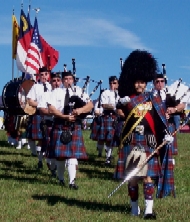
 Regional Scottish heritage organizations partnered with the Guild for this event, and the public enjoyed an array of colorful tartans, clan flags and entertainment by the finest Scottish folk artists in the region. Honored guest speaker for the 2PM Opening Ceremony was Royce McNeill, the director of the annual Highland Games at Grandfather Mountain (which is scheduled this year for July 11-14).
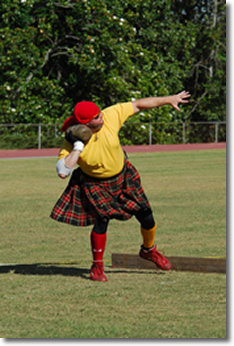 Some of Scotland's best traditional craftspeople are represented in "Celebrating Scotland's Crafts," providing a remarkable opportunity to view long-established crafts in their most authentic forms. Certainly among the highest-profile of all Scottish traditions is the wearing of tartans by Scottish families, or clansmen. Made into sashes and kilts for ceremonial (and at one time, military) use, tartans have long identified a Scot's specific heritage, either geographic or genetic. A tartan refers to a plaid of distinct color and stripe, typically woven from wool.
  Nothing calls to mind the essence of Scottish culture quite like the haunting song of the Highland bagpipe. The elaborate, double-reed, woodwind instruments developed in the 14th century, require of the craftsman specialized engineering skills as well as an artistic sense and a good ear for music. Simply playing the bagpipe takes physical coordination and a good deal of lung power and strength. There are several types of bagpipes, including the Highland and Lowland pipes, the Border pipes, the small pipes and the reel pipes, each playing a different role in Scottish heritage. Known best for the crisp melodies and droning undertones carried by Scottish regiments, bagpipes were once used to sound the curfew through the streets of Scottish border towns. Today they are also heard in folk bands, or solo, reverently leading hymns. Historically, pipes were made with local woods until the British colonization brought exotic woods like ebony and African blackwood. These woods are still used today.