 | greenville business & community directory |
|

This is an archived page that may contain outdated or incorrect information. Please visit www.Greenville.com for the latest news, events, and more.

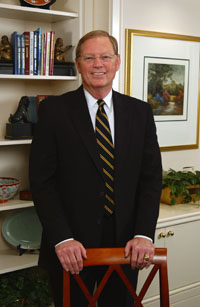 Executing a carefully thought-out plan, Frank D. Pinckney, Greenville Hospital System President and CEO, recently announced his plans for retirement, setting in motion a disciplined selection process for his successor.
The seven-member GHS Board will now conduct a nationwide search for Pinckney's replacement. On January 2, 1963, Robert E. Toomey, then CEO of Greenville General Hospital, hired Pinckney as Assistant Manager of the hospital's charity care program. Since then he held a series of successive Greenville Hospital System managerial positions that included Senior Vice President of Acute Services and Executive Vice President. His GHS career culminated with his being appointed President and CEO in December 1991. Four years ago Pinckney informed senior members of the sitting GHS Board that he intended to hand on leadership of the Greenville Hospital System in calendar year 2006 during which he would reach the age of 68. It was his purpose at that time to prepare the Board for the task of succession management while allowing himself time to bring to completion the goals he had established for the organization. Those goals included the following:
GHS made another major advancement in medical academics in 2005 when the Medical University of South Carolina and the University of South Carolina integrated their pharmacy programs and announced that the South Carolina College of Pharmacy would add Greenville Hospital System as a clinical training campus. Under Pinckney's direction, GHS joined Clemson University, the University of South Carolina, and the Medical University of South Carolina in announcing that their organizations were pledging a combined $24 million to biomedical and health sciences research in the Upstate, all of which will be conducted on the campuses of the Greenville Hospital System. In late 2005, the University of South Carolina and the Medical University of South Carolina announced plans for their presence in the Greenville Hospital System Research, Education and Innovation Institute. The University of South Carolina announced it was expanding the USC School of Medicine, the USC College of Nursing, the South Carolina College of Pharmacy (a college operated jointly by USC and the Medical University of South Carolina), the Arnold School of Public Health, and the USC College of Social Work into the education wing of the Institute.
In 1992, Pinckney's leadership resulted in the GHS Board of Trustees authorizing a $2 million contribution to the William R. DeLoache Center for Developmental Services (CDS), an organization that provides children and adolescents with developmental needs access to multiple programs and services in a single location. In 2003, when one of center's partners announced it would no longer provide children's rehabilitation services at CDS, Pinckney announced GHS would add staff positions and make another financial commitment to support CDS programs and services and to aid with the capital campaign on the facility. In 1992, Pinckney convinced the Board of Trustees to donate $1 million toward the construction of a Nursing/Science building at Greenville Technical and Community College to help train the area's future allied health professionals.
In addition, Pinckney oversaw the completion of the Robert E. Toomey Education, Research, and Conference Center - which provides education and training space for hospital employees and nursing students, and the construction of a new bed tower that increases Greenville Hospital System's total capacity to 1110 licensed beds - and he is responsible for acquiring the property for the system's Patewood Medical Campus. Already under construction on a new, state-of-the-art Greer campus are an innovative nursing center and a new acute-care hospital. Throughout his tenure Pinckney maintained an unwavering commitment to putting patients first, to supporting physicians, and to building a top-notch medical team. Toward that end, he directed the conversion of Greenville Memorial Hospital to an all-private room facility; he updated the system's visitation policy to reflect a more patient-friendly and staff-supporting focus; he directed a pay increase for all GHS registered nurses providing acute patient care, making Greenville Hospital System nursing salaries the highest in the region at that time; and he oversaw the growth of the Greenville Hospital System Medical Staff from 669 in 1991 to 1151 today. Noting that he had seen many positive changes in the healthcare industry over his career, he said one thing has not changed - healthcare remains first and foremost a "people business." The desire to make a difference is what attracted him to healthcare in the first place and it is what continued to motivate him over his 43-year career. (Images provided by Greenville Hospital System.)
|

 In 2004, Pinckney was among the architects of Health Sciences South Carolina, the statewide research collaborative established for the purpose of improving the health and economic well being of South Carolina.
