 | greenville business & community directory |
|

This is an archived page that may contain outdated or incorrect information. Please visit www.Greenville.com for the latest news, events, and more.

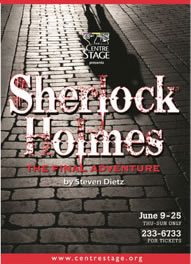 You know what he wears around his shoulders and on his head. You know what he smokes, what he shoots up, and what he says to his sidekick. You might even know his address, though it never really existed.
You know his profession, his preternatural powers of observation, deduction and abductive reasoning, his imperious air and his foibles. If your own powers of observation, deduction and abductive reasoning are sufficient, you've probably long ago arrived at who "he" is. But for the record: It's elementary. He's Sherlock Holmes, the invention of a Scottish writer named Sir Arthur Conan Doyle. Greenville's Centre Stage proudly brings you a wonderful mystery by Steven Dietz on June 9 - 25. Back before 2005, when he got a commission by the Arizona Theatre Company to write a new play about the supersleuth, Dietz knew -- like nearly everybody else on the planet -- the legend of Holmes. "But I had never read a single story or saw any of the movies," Dietz said from his home in Austin, Texas. I had zero knowledge." Fortunately for Holmes fans, the 49-year-old Dietz is one of the most prolific and successful playwrights outside New York.
It's now in previews and opens Wednesday at the Play House in a co-production with Geva Theatre in Rochester, N.Y. Still, it was a scary assignment. "It was a huge and daunting challenge because of the expectations on the part of the fans and the casual observer," said Dietz, who teaches at the University of Texas but still keeps a home in Seattle, where the Colorado native built his career. "How do you meet those expectations and come up with surprises? Surprises are essential to the theater." Dietz had his own surprise in store. In reading Conan Doyle's 56 stories and four novels, as well as many of the previous stage and screen adaptations, Dietz discovered a literary treasure he had previously overlooked. "Holmes is a brilliant creation," Dietz said. "He's got these near-supernatural powers, but he's just human enough. He exists on the outer fringes of where we all wish we could perceive and think, where we can aspire to." Studying Holmes was like "opening a Pandora's box; it was like playing a Beatles album for my 8-year-old daughter, and she says: 'They're pretty good. Did they ever do anything else?' " After his research, Dietz decided to adapt an 1899 play by American actor William Gillette, one of the first men to play Holmes onstage. It is based largely on two of Conan Doyle's stories. From "A Scandal in Bohemia" (1891), the first Holmes story to appear in Strand Magazine and to be illustrated by Sidney Paget, Gillette took Irene Adler, the opera singer who is an ostensible villain and the only woman in whom Holmes shows a hint of romantic interest. And from "The Adventure of the Final Problem" (1893), in which Conan Doyle kills Holmes (but revived him in 1901 and continued writing Holmes stories until 1926), Gillette took Professor James Moriarty, the evil mastermind behind most of England's criminals. Gillette added his own wrinkles, including the curved pipe (Paget's straight pipe would have hidden too much of the actor's face), and the Inverness cape, and played a key role in formulating what would become a famous phrase: "Elementary, my dear Watson." Drawing on the play and the two stories, Dietz made his most satisfying discovery: The stories work not so much because of the complexity of the cases ("they're actually pretty simple, straightforward") but because of relationships. The first is between Holmes and his chronicler and friend, Dr. John Watson. "We could not stomach Holmes on his own," Dietz said. "He's brilliant, but he's abrasive, a cocaine addict, but between the two of them you have one superhero. The head and the heart, in the most black and white terms. The second is Holmes' complicated connection with Moriarty. "Holmes has great admiration and respect for him, thinks he has a masterful mind," Dietz said. "He can't be at his best without Moriarty and vice versa. They bring out the best and worst of each other." If Holmes is a genius, so is Conan Doyle, Dietz said. Then Dietz used a timely baseball metaphor to illustrate his point. "That's when I realized what a good author Conan Doyle was," Dietz said. "He created these three dependent, essential characters who are necessary for each other to exist. It's like the Red Sox and the Yankees. Or maybe I should say, the Red Sox and the Indians." For tickets and more information, please visit visitor center. (Image provided by Centre Stage)
Looking for more happenings in the area? Check out Greenville.com's comprehensive visitor center.
|

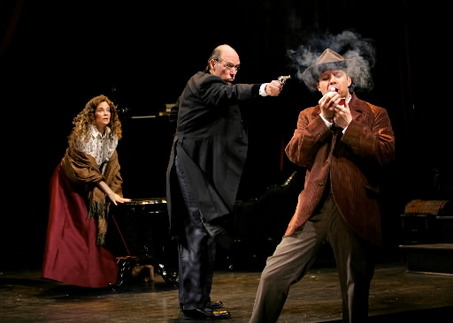 Like Holmes, he's a quick and accurate study. The play he wrote, "Sherlock Holmes: The Last Adventure," premiered in 2006, won an Edgar Award from the Mystery Writers of America and has been produced around the country.